
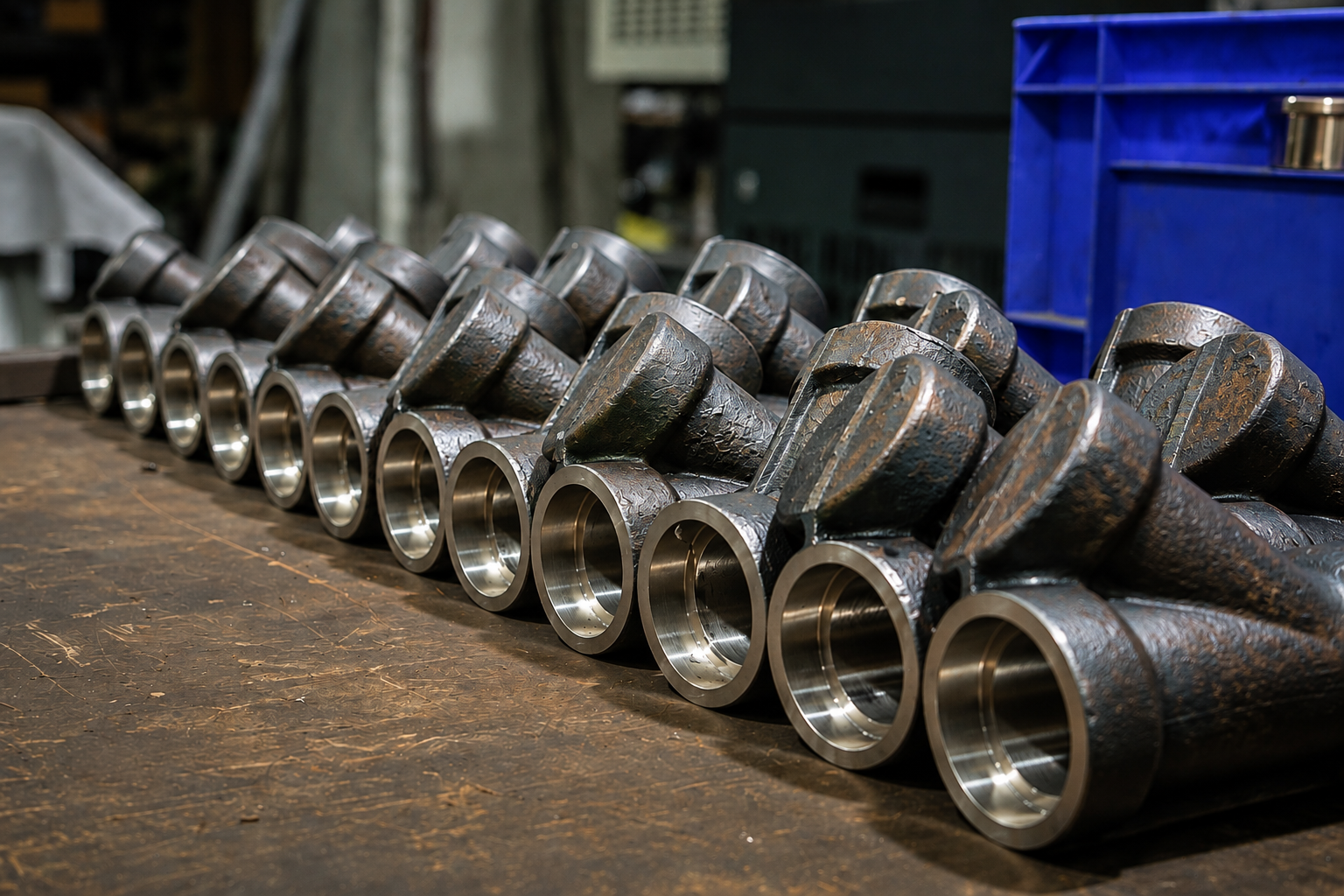
Socket weld and threaded are the two most common ways to join small-bore CuNi piping, and the choice between them shapes how a system installs, performs and gets maintained for the rest of its service life. Neither is universally "better" — each solves a different problem, and specifying the wrong one usually shows up later as a maintenance headache or an unnecessary leak path.
How Each Connection Works
Socket weld fittings have a machined recess sized to accept the pipe end, which is inserted until it seats against an internal shoulder and then fillet-welded around the joint. The result is a permanent, continuous metallic bond with no threads to loosen or seal compound to fail. Threaded fittings instead rely on matching NPT, BSPT or BSPP threads machined into both the fitting and the pipe end, sealed with thread sealant or tape, and tightened mechanically rather than welded.
Comparing the Two
| Factor | Socket Weld | Threaded |
|---|---|---|
| Installation method | Fillet welded — requires a qualified welder | Mechanically threaded — no welding equipment needed |
| Leak-tightness | Continuous metallic bond, no seal to fail | Depends on thread engagement & sealant condition |
| Disassembly for maintenance | Requires cutting the joint | Can be unscrewed and reassembled |
| Vibration & cyclic loading | Excellent — no loosening risk | Threads can work loose under sustained vibration |
| Typical pressure classes | 3000 / 6000 / 9000 | 2000 / 3000 / 6000 |
| Best suited for | Permanent high-pressure runs, cooling & process lines | Instrumentation, utility lines, serviceable connections |
Pressure Rating & Service Conditions
Both connection types are manufactured to ASME B16.11, but their pressure classes reflect how each joint actually behaves under load. Socket weld fittings, backed by a full metallic weld, are generally the safer choice for the higher end of the pressure range and for services involving thermal cycling or vibration — the weld doesn't rely on friction or sealant to stay tight. Threaded connections are perfectly adequate at moderate pressures but lose some margin at the joint itself, since thread engagement can degrade over time from vibration, thermal expansion, or repeated disassembly.
Maintenance & Serviceability
This is where threaded connections earn their keep. A threaded union, plug or coupling can be removed with hand tools for inspection, cleaning, or component replacement, then reassembled without cutting into the piping run. Socket-welded joints don't offer that flexibility — once welded, disassembly means cutting the pipe and re-welding a new fitting. For that reason, threaded fittings are common at instrumentation tie-ins, sample points, and anywhere equipment is expected to be serviced or swapped over the system's lifetime.
Cost & Lead Time
Threaded fittings are typically faster to install on site since no welding, post-weld inspection or hot-work permit is required — a meaningful advantage on time-constrained retrofit or shutdown work. Socket weld installation costs more in labor and inspection but avoids the ongoing risk of a mechanical joint loosening, which can matter more over a multi-decade asset life than the up-front installation saving.
A Simple Way to Decide
As a rule of thumb: specify socket weld for permanent, high-pressure or vibration-prone runs where the joint will never need to come apart — main cooling loops, structural process piping, anything below deck that's difficult to access later. Specify threaded connections where you expect to service, remove or reconfigure the connection during the system's life — gauges, sample points, drains, vents and utility branches.
In short: socket weld favors permanence and pressure integrity; threaded favors serviceability and installation speed. Most real piping systems use both, matched to what each section of the run actually needs.